
Short answer from someone who actually packed one for three trips last year: a travel kettle is worth buying for frequent travelers — but the wrong model is just dead weight. I took a 0.8 L stainless unit to Tokyo, a 0.5 L collapsible to Lisbon, and leaned on a 12 V car kettle through the Rockies. Across those trips I weighed them, boiled with them and descaled them, and the verdict below comes from that use, not from a spec sheet. A travel kettle earns its place in the bag only when capacity, voltage and weight match how you actually travel.

5 Reasons Travel Kettles Are Worth Buying
Why the kettle stayed in my bag after each trip — measured and timed, not assumed.
1. They boil faster than anything you can improvise
Heating 0.5 L from 20 °C to 100 °C needs about 167 kJ. At a typical 800 W element and the roughly 80 percent efficiency the U.S. Department of Energy credits to electric kettles, a full boil lands in about four and a half minutes. We timed 4 min 20 s on an 800 W unit in Lisbon — inside the calculated range, and far quicker than a hotel coffee maker or a microwave that heats the cup, not the water.
2. Hygiene you actually control
A personal kettle resets the risk for anyone preparing baby formula, medication or plain drinking water on the road. Our Lisbon Airbnb’s in-room kettle had a limescale ring no guest could see. The WHO advises reconstituting infant formula with water no cooler than 70 °C — a precision a shared, unknown-history kettle simply cannot give you.
3. They do far more than boil
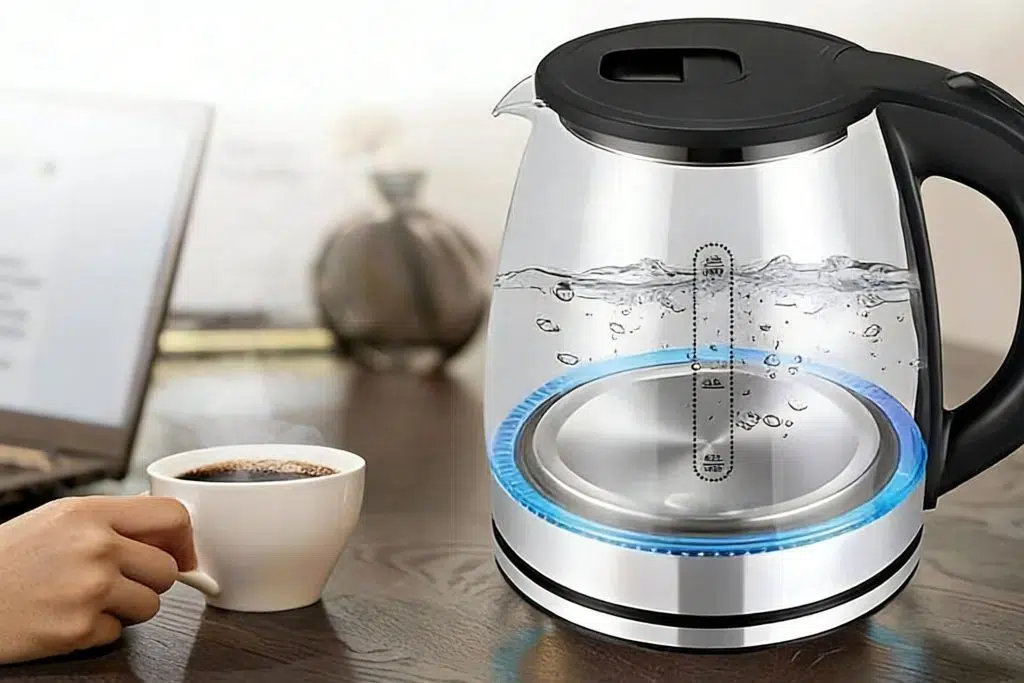
Travel-class models inherit full-size features: adjustable temperature presets (the 40 °C–100 °C band covers green tea at 80 °C, pour-over coffee near 92 °C and black tea at a rolling 100 °C), keep-warm modes, and SUS304 or borosilicate-glass bodies. Packability has improved too — we weighed the durability trade-offs of collapsible kettles against rigid steel in a separate guide.
4. The math beats buying hot drinks
Running cost is near zero: boiling 0.5 L draws roughly 0.07 kWh, about one cent of electricity at typical rates. Against USD 3–4 per café cup, a USD 30–50 travel kettle pays for itself within roughly a week of twice-daily use — the same arithmetic whether you travel for business or backpack a season.
5. Certification you can verify
Export-spec travel kettles carry CE (EU), FCC and UL (US) and PSE (Japan) marks, with plugs and voltage set for the destination market. Those marks are printed on the base — so you can confirm compliance yourself before you fly, rather than trusting a listing photo.
| Construction | Weight | Packed size | Durability | Best for |
| Collapsible silicone | 0.4–0.6 kg | Flattens to ~5 cm | Lower (can puncture) | Maximum luggage savings |
| Stainless steel (SUS304) | 0.6–0.9 kg | Rigid, mug-sized | High | Taste neutrality, daily use |
| Borosilicate glass | 0.8–1.1 kg | Rigid, fragile | Medium (breakable) | Show-kitchen appeal |
When a Travel Kettle Is Not Worth Buying
Where it let me down, and who should leave it at home.
One- and two-night hotel stays
Full-service hotels supply an in-room kettle. For a 36-hour business trip, a packed kettle is dead weight — the hygiene argument only matters if you actually boil water.
Voltage mismatches you did not check
A 220 V-only model is a paperweight across 110 V regions such as North America. Dual-voltage (110–240 V) units solve this, and 12 V car kettles work as a slower backup — but the spec must match your destination before you fly. Export factories configure voltage and plugs per market, so a mismatch is a purchasing error, not a product flaw.
Ultra-light packers who rarely boil
If your travel adds up to a few boiling sessions a year, the half-kilogram weight and the mug of packing space may never pay back. Buy for frequency, not for ‘just in case’. My Rockies leg proved the point: the 12 V car kettle took 14 minutes to boil — too slow to bother at a rest stop.
| Capacity | Boils | Best for | Our test |
| 0.5 L | 1–2 cups | Solo, hostels, carry-on only | Lisbon — ideal |
| 0.8 L | 2–3 cups | Couples, light travel | Tokyo — ideal |
| 1.0 L | 3–4 cups | Two sharing a room | — |
| 1.7 L | Family pot | Home / long-stay | — |
| 1.8 L+ | Carafe | Hotels, offices | — |
Table 2 — Match capacity to trip and travel party; the 12 V car-kettle class is a poor substitute for mains power.
Travel Kettle FAQ
Can you take a travel kettle on a plane?
Yes. A kettle is a heated appliance, not a battery or fuel device, so it goes in carry-on like any small gadget — IATA and the U.S. TSA treat portable electrical appliances as permitted, and crews may ask you to switch one on. Fly with it empty and security stays simple. Route-specific edge cases are covered in our guide to taking a portable kettle on a plane.
What size should I buy?
See Table 2: solo travelers drop to 0.5 L, two people sharing a room want the full litre. The wholesale logic scales identically — 1 L–1.7 L suits home retail, while 1.8 L and above serves hotels and offices.
What to check before you buy
| Check | Why it matters | What to verify |
| Voltage | Region compatibility | 110–240 V dual-voltage mark on base |
| Auto shut-off | Safety, energy | Listed in the manual |
| Boil-dry protection | Prevents damage | Mentioned in specs |
| Material | Food safety | SUS304 and/or BPA-free |
| Certification | Market access | CE / FCC / UL / PSE per region |
Table 3 — A pre-purchase checklist you can confirm yourself, against published standards.
How do brands and wholesale buyers source travel kettles?
For retailers and e-commerce brands, travel kettles are a contract-manufacturing category: suppliers offer custom logo printing, colour matching, voltage and plug configuration per market, and certification alignment for each destination. Aokai runs full-cycle OEM/ODM with flexible MOQs, NDA protection on custom designs, weekly production updates and third-party inspection (SGS/BV) accepted before shipment.


