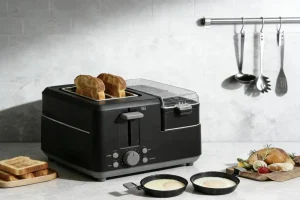
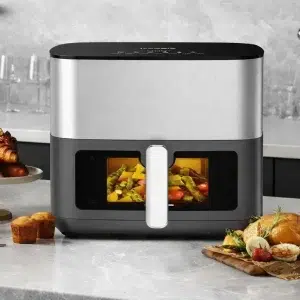
A countertop smart air fryer and a countertop air fryer oven look similar from the outside — both are boxy, both have a glass door or basket window, and both crisp food without a deep fryer. The difference is what happens on the inside. A standalone air fryer concentrates hot air in a small chamber at high velocity, which is why fries finish in 12 minutes and wings come out crackling. An air fryer oven spreads that same hot air across a much larger cavity with multiple racks, which is why a whole chicken and a tray of vegetables can finish in the same cycle.
The choice between the two comes down to a single trade-off. Speed and crispiness in a small footprint, or capacity and versatility at the cost of a few extra minutes. This guide breaks down airflow, capacity, presets, energy use, and total cost of ownership so a buyer can match the appliance to the way they actually cook.
| Feature | Air Fryer | Air Fryer Oven |
| Footprint | Compact, fits a small counter | Larger, needs dedicated counter space |
| Capacity | Best for 1–3 servings | Best for 4–8 servings |
| Cooking Modes | Mainly air frying | Baking, broiling, roasting, toasting, air frying |
| Speed | 20–30% faster than a conventional oven | Slightly slower than a basket air fryer |
| Airflow | ~12 m/s concentrated jet | 8–10 m/s with fan + convection element |
| Price (USD) | $40–$150 retail | $120–$350 retail |
| Best For | Singles, couples, quick meals | Families, batch cooking, oven replacement |
Key Takeaways
- Air fryers cook food 20–30% faster than air fryer ovens because their compact chamber keeps heat close to the food and the fan runs at higher RPM.
- Air fryer ovens hold 2–4× more food per cycle and combine air frying with baking, broiling, and roasting in one appliance.
- A buyer should match the appliance to the household: 1–3 servings → basket air fryer; 4+ servings with varied menus → air fryer oven.
What an Air Fryer Actually Does
An air fryer is a small kitchen appliance that sits on the counter and cooks food by moving hot air around it with a tablespoon or less of oil. A heating element sits above the basket that holds the food. A high-speed fan pulls that heat down and pushes it sideways across the food’s surface. The Maillard reaction then browns the outside, which is what creates the “fried” texture without submerging the food in oil.
The airflow happens in a fixed order:
- The heating element reaches the set temperature (usually 300–400°F).
- The convection fan pulls hot air from the heating element down into the cooking chamber.
- The fan pushes this hot air around the food on every side.
- The fast, even circulation strips moisture from the surface so the outside browns instead of steams.
- Heat reaches the food from every direction, so the cook does not need to flip halfway through.
The small cooking chamber is the actual design advantage. A compact space keeps heat close to the food, which is what gives a basket air fryer its speed advantage over a regular oven or a full-size convection oven. The trade-off is capacity. A 4-quart basket fits two chicken breasts or one layer of fries. Anything more than that means a second cycle.
Wattage and What It Means for a Buyer
Wattage is the most useful number on the spec sheet once the buyer knows their kitchen circuit. Underwriters Laboratories certifies household cooking appliances for a 15-amp branch circuit, which means any 120V air fryer that draws more than 1,800 W will trip a standard kitchen outlet when another appliance runs on the same circuit.
| Size | Capacity | Typical Wattage | Breaker Headroom |
| Small | 2 qt or less | 800 – 1,300 W | Safe on any 15A circuit |
| Medium | 3 – 6 qt | 1,400 – 1,800 W | Safe alone; trip-risk with toaster on same circuit |
| Large / dual-basket | 8 – 12 qt | 1,800 – 2,000 W | Needs a dedicated 15A or 20A circuit |
A top temperature of at least 400°F is best for getting a crispy crust. These features work well for fries, wings, vegetables, and reheating leftovers. A standalone basket air fryer fits one to three servings. In our experience on the production line, the 5–6 quart basket is the sweet spot for a couple or a small family — large enough for two chicken breasts plus a side, small enough to preheat in under three minutes.
Smart Air Fryer Types on the Market Today
A “smart air fryer” is not one product. It is a category that includes at least three distinct form factors, and the right one for a buyer depends on what they cook, how many people they feed, and how much counter space they have. Manufacturers like ours design to all three, with the basket, toaster-oven, and dual-basket formats each serving a different cooking pattern.
| Type | Best For | Typical Capacity | Why a Buyer Picks It |
| Basket air fryer | Singles, couples, quick meals | 2–6 qt | Fastest preheat, lowest price |
| Air fryer toaster oven | Families, varied menus | 15–26 qt | Replaces a toaster oven and a small oven |
| Smart double air fryer | Households that cook two foods at once | 7–10 qt total | Two independent zones, no flavor crossover |
Basket air fryers are the entry-level category and the highest-volume wholesale SKU. Air fryer toaster ovens are the fastest-growing segment because they replace two appliances with one.
The smart double air fryer format — two baskets with independent time and temperature settings — is the premium choice for households that want to cook a protein and a side at different settings without mixing flavors.
“In our experience shipping all three formats to North American and EU retailers, the dual-basket version has the highest return-rate of any air fryer type, almost entirely because buyers overload both baskets on day one. A 7-quart dual-basket unit still only has so much airflow per basket.”

What an Air Fryer Oven Offers
An air fryer oven is essentially a larger oven with an air frying mode. It provides baking, broiling, roasting, toasting, and air frying in one appliance. The NSF/ANSI 4 standard for commercial cooking equipment defines the temperature-holding tolerances these multi-mode ovens have to meet before they can carry an NSF mark, which is the cleanest way for a buyer to tell whether a “multi-function” oven actually performs across modes or just lists them on the box.
Larger Size and Multi-Mode Functions
A mid-range oven air fryer typically holds 21 quarts. Its exterior dimensions measure 16.1 × 12.6 × 13.7 inches, and it weighs 20.04 lbs. The stainless steel body includes features like 9 automatic programs, extra-crisp technology, and no pre-heating. The usable interior fits a whole roasted chicken up to 7 lbs, 6 slices of bread, a 12-inch pizza, or 13 cookies on standard racks. This capacity serves up to six people in one cycle.
The multi-mode design is what makes an air fryer oven a real oven replacement rather than an oversized air fryer. Buyers who want one appliance that handles weeknight fries, weekend roasts, and the occasional bake will end up here.
Mechanism and Cooking Compared to Air Fryers
The air frying mechanism in an air fryer oven is milder due to its larger space and fan placement. A standalone air fryer uses a compact chamber with a high-speed fan that circulates hot air aggressively around and underneath the food. Heat reaches the food from all angles quickly. An air fryer oven adds a fan that circulates hot air more actively than a still oven, giving more even results. However, the larger cavity and lower airflow intensity mean longer preheats and less concentrated heat than a dedicated basket air fryer.
The oven’s air-fry mode runs the convection fan at higher intensity, yet the larger cavity still results in longer preheats and weaker airflow compared to a dedicated basket. The concentrated, high-speed airflow in a dedicated basket air fryer produces the fastest cook speed. An air fryer oven is moderate, and a conventional oven is slow. When converting non-air-fryer recipes, shorten the cooking time by 20–25% to prevent overcooking.
Size and Capacity Differences
Air Fryer Basket Capacity Limits
The basket shape defines the main limit for countertop air fryers. A typical unit uses a round or square basket that holds food in a single layer. Crowding the basket blocks hot air from reaching every piece, and food steams instead of crisping. Capacity ranges from 2 quarts for small units to 9 quarts for large dual-basket designs. Serving sizes follow a simple rule based on these volumes.
| Capacity (Quarts / Liters) | Recommended Serving Size (People) |
| 2–3 qt (2–3 L) | 1 person |
| 3.5–4 qt (3.5–4 L) | 1–2 people |
| 4.5–5.5 qt (5–6 L) | 2–3 people |
| 6–7 qt (6–7 L) | 3–4 people |
| 7.5–9 qt (8–9 L) or dual 2×4 L | 4–6 people |
| 10+ qt (10+ L, oven-style) | 5–8 people |
These figures show how basket limits affect meal planning. A 2–3 quart basket cooks a single chicken breast or one portion of fries. A 4.5–5.5 quart basket fits two standard servings of wings or vegetables. Families that serve four or more people often cook in batches. One basket load cooks small portions; larger households must run multiple cycles to finish a meal.
The 1-quart-per-person rule offers a starting point. Two people need 3–4 quarts. Four people need 5–6 quarts. Six people need 6–8 quarts. Cooking style changes the number — people who batch cook or entertain should size up. Countertop basket air fryers focus on quick, small meals.
How Air Fryer Ovens Handle Batches
Air fryer ovens solve the batch problem. A mid-range oven holds 21 quarts. This interior fits a 7 lb chicken, six slices of bread, a 12-inch pizza, or 13 cookies. The oven-style design uses multiple racks. One rack holds fries while another rack holds chicken. The large cavity serves up to six people in one run. Batch cooking becomes simple. Users do not need to wait for one basket to finish before starting another.
Oven models with 10 quarts or more fit five to eight people. The open space spreads food across trays. Air circulates around each piece evenly. Cooks can prepare an entire meal at once, which saves time for larger households. A 21-quart oven fits a full sheet of fries on one rack and chicken wings on another. Both racks cook at the same temperature. The fan moves air around both levels. This design cuts total cooking time for the whole meal. Users do not need to time separate batches. The oven features adjustable rack positions for different food types. An air fryer oven handles multiple dishes without delays. The choice between basket and oven often comes down to batch size. Small batches favor compact units. Large meals need the bigger appliance.
Cooking Time and Airflow Mechanism
Speed of Air Fryers vs. Air Fryer Ovens
A basket air fryer cooks faster than an air fryer oven for two reasons: it has a smaller space and a stronger fan. The small chamber keeps heat close to the food. The strong fan pushes that heat around very fast. This combo removes the cool, wet air layer on the food’s surface. Moisture dries up quickly. The dry surface then turns brown through the Maillard reaction.
When converting normal oven recipes for a basket air fryer, cut the cooking time by about 20–30% and lower the temperature by roughly 25°F. A dish that takes 60 minutes in a regular oven usually finishes in about 45–48 minutes. A 30-minute oven recipe becomes 20–24 minutes. A 20-minute recipe becomes 14–16 minutes. These changes stop over-browning while keeping food crispy.
Why Airflow Intensity Matters
Airflow intensity separates these appliances more than anything else. Measured air speed tells the story.
| Appliance Type | Measured Air Speed |
| Air fryer | ~12 m/s |
| Convection oven (standard fan) | 1–3 m/s |
| Convection oven with air-fry mode | 8–10 m/s |
A dedicated basket air fryer moves air at roughly 12 m/s. A standard convection oven reaches only 1–3 m/s. Even a convection oven with an air-fry mode tops out at 8–10 m/s. This gap explains why basket air fryers cook faster and make crispier results.
“An air fryer takes this idea to the extreme. It has a strong heating element and a big, high-speed fan. This makes a vortex of intense heat. This fast airflow quickly strips away the thin layer of cooler air that acts like a blanket. By removing this barrier, heat can reach the food much faster than in a regular oven.”
The link between airflow and crispiness follows a clear pattern. More airflow lets water evaporate and crisps the product. Using racks helps crisping by letting air surround the food. Perforated pans help airflow around the product. The right fan speed helps get a crispier result. Air pulling moisture away speeds up the second stage of air frying. Food sitting below the sheet pan rim blocks airflow and lowers crisping.
When to Choose an Air Fryer
Best for Small Households and Quick Meals
People who live alone, couples, and small families get the most from a small basket air fryer. These units cook one to three servings at a time. A chicken breast or some fries is done in ten to fifteen minutes. That speed works well on busy weeknights when someone wants dinner fast. Basket air fryers also make food crispier than toaster ovens with air-fry settings. Many cooks prefer that extra-crunchy texture for wings, vegetables, and frozen snacks. The small chamber keeps heat close to the food, so the outside browns fast. One downside: users cannot see the food cooking without opening the basket. They have to stop the cycle to check how it is going. Even so, the fast, crispy results are worth that small hassle for small households.
Space-Saving and Budget-Friendly Option
Counter space is important in apartments and small kitchens. A dedicated basket air fryer takes up much less room than a full oven or a large air fryer oven. It also costs much less than a toaster oven with an air-fry mode. Buyers watching their budget find this price gap appealing. The small size lets users keep the appliance on the counter every day. That easy access makes people use it often. For anyone who wants speed, simplicity, and a low price, a small basket air fryer is still the practical choice.
When to Choose an Air Fryer Oven
Ideal for Larger Families and Versatile Cooking
An air fryer oven works well for families with four or more people. Models that hold 6.8 to 8 quarts give enough space for a whole family meal, and 21-quart toaster-oven-style units serve six comfortably. One reviewer noted a 5.8-quart unit felt too small for four people. These appliances come with many cooking modes, including baking, roasting, broiling, toasting, and air frying. Some models have up to 13 presets, while others offer 8 one-touch smart programs. This range of options can replace several small kitchen gadgets. Rapid air technology cooks food evenly on all sides with no cold spots. Families get healthier meals with a crispy outside. Cleaning is easy because the trays and baskets are dishwasher-safe.
Handling Multiple Dishes and Batch Cooking
The bigger inside space solves the batch cooking problem for good. Unlike smaller air fryers, an oven air fryer fits a whole dinner in one cycle. The air fry abilities create crispy results while the roomy cavity holds several dishes. Users do not have to run many loads for one meal. Dual-zone models let a buyer cook two different foods at once without mixing flavors. Smart Finish technology makes sure both baskets finish at the same time. This design saves time on busy weeknights. An air fryer oven moves air with more force than a standard convection oven for faster cooking. Cooks can air fry chicken wings on one rack while baking potatoes on another. This flexibility makes the appliance a real oven replacement for households that have stopped using their built-in wall oven.
How Buyers Decide Between the Two
The choice comes down to a simple trade-off. A basket air fryer wins on speed, size, and simplicity. An air fryer oven wins on versatility, capacity, and cooking several dishes at once. The decision framework below summarizes the four variables a buyer should weigh before clicking “Add to Cart.”
| Decision Variable | Favors Basket Air Fryer | Favors Air Fryer Oven |
| Household size | 1–3 people | 4+ people |
| Counter space | < 18 inches wide | > 22 inches wide |
| Cooking style | Reheat + frozen snacks + weeknight protein | Weekly roast + batch cooking + bake |
| Budget | < $100 retail | $150–$350 retail |
The measured airflow gap — basket at ~12 m/s versus oven at 8–10 m/s — is what produces the texture difference most buyers notice first. A buyer who already has a working wall oven and mainly cooks for one or two is usually better served by a 5-quart basket model that preheats in three minutes and parks on the counter. A buyer who has stopped using their wall oven because it heats the whole kitchen in summer is the customer for whom an air fryer oven replaces a $2,000 appliance.
FAQ
Can an air fryer oven replace a regular oven?
Yes, for most households. An air fryer oven bakes, broils, roasts, toasts, and air fries. A 21-quart model fits a 7 lb chicken or a 12-inch pizza. The exception is large holiday roasts over 12 lbs or full sheet-pan baking for a crowd — those still go in a full-size wall oven.
Do air fryers use a lot of oil?
No. A dedicated basket air fryer needs very little oil — a tablespoon or less for a full basket of fries. Its strong fan moves air at roughly 12 m/s. That fast airflow creates a crispy surface without deep frying. For reference, a typical basket of fries absorbs about 4 g of oil in an air fryer versus 14 g in a deep fryer.
How do I adjust a regular recipe for an air fryer?
Cut the cooking time by 20–30% and lower the temperature by about 25°F. A 30-minute oven recipe becomes 20–24 minutes. For dense foods like chicken thighs, shake or flip halfway through. For leafy vegetables, check at the minimum time and pull early to avoid burning.
Which type is more energy-efficient?
A basket air fryer is more energy-efficient per cycle because of the smaller chamber and shorter cook time, but an air fryer oven can replace the use of a full-size wall oven for many households. The break-even depends on how often the wall oven was being used. Buyers comparing models can use the Energy Star product finder to look up annual energy use in kWh for specific SKUs.
Are air fryer ovens safe to leave unattended?
Same rules as a regular oven — no cooking appliance should be left unattended for long periods. The UL safety standard for household cooking appliances requires auto-shutoff and over-temperature protection on all certified countertop air fryers and toaster ovens. Buyers should look for the UL or ETL mark on the rating plate before purchasing.